
Short answer
Do not choose a plumbing pipe system from material name alone.
For a building in Cyprus, first define what the pipe will carry, where it will be installed, the design temperature and pressure, the hydraulic demand, the jointing method, access for maintenance and the complete manufacturer-supported system of pipe and compatible fittings.
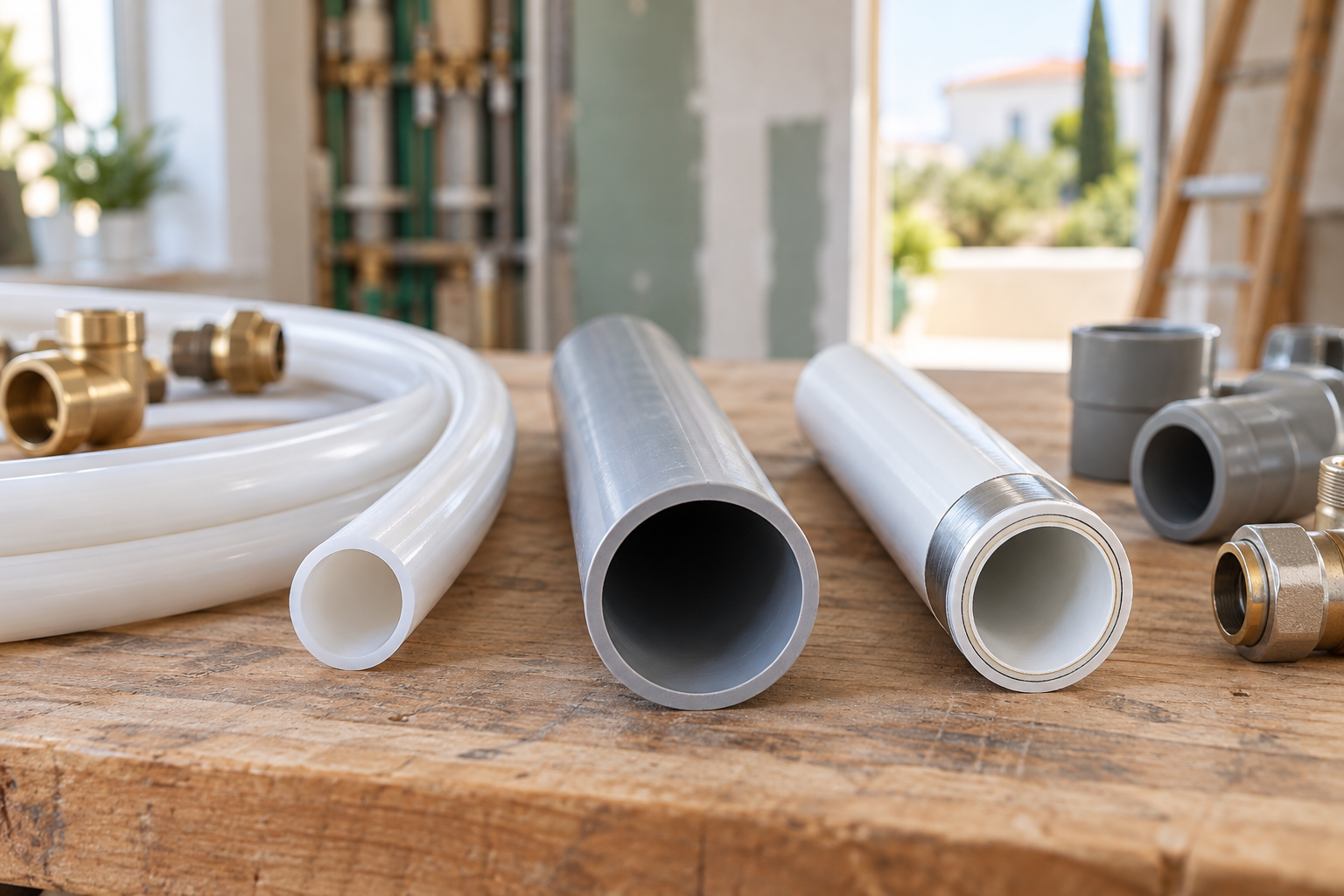
PE-X, polypropylene and multilayer systems can all be appropriate in the applications covered by their relevant product standards. The correct choice depends on the project and the manufacturer's declared system limits.
1. Define the application before comparing materials
Start by separating the actual services:
- cold potable water;
- domestic hot water;
- closed heating circuits;
- pipework buried outside the building;
- exposed or service-shaft pipework;
- concealed pipework inside floors or walls;
- specialist services that may have their own specification.
A pipe system suitable for one of these applications should not automatically be assumed suitable for all the others.
The CYS EN 806 series provides the general design, sizing, installation, operation and maintenance framework for water installations within buildings and pipework within the premises. Product-specific standards then define the characteristics of particular piping-system families.
2. Treat pipe and fittings as one system
A plumbing installation is not only a length of pipe.
The selected system includes:
- pipe;
- fittings;
- jointing method;
- transition fittings;
- supports and fixing details;
- insulation where required;
- valves and service components;
- the manufacturer's installation procedure.
Do not assume that fittings from one manufacturer or system are interchangeable with another simply because the nominal pipe size appears similar.
Compatibility should be confirmed from the relevant system documentation.
3. Check the declared application class, temperature and pressure
Plastic and multilayer piping standards define service conditions rather than one universal operating limit for every installation.
Before specifying a system, verify the manufacturer's declared:
- intended application;
- design pressure;
- design temperature or application class;
- maximum permitted operating conditions;
- pipe dimension/class;
- fitting and joint compatibility.
CYS EN ISO 15875 covers PE-X systems for hot and cold water installations and heating systems under defined application classes and design pressures. CYS EN ISO 15874 does the same for polypropylene systems. CYS EN ISO 21003 covers multilayer systems for hot and cold water installations inside buildings.
The practical lesson is simple: do not select from the material acronym alone.
4. Size from hydraulic demand, not from habit
Pipe diameter should follow the hydraulic design.
The CYS EN 806 framework includes a pipe-sizing methodology for standard drinking-water installations. The design should consider the actual draw-off arrangement, available pressure and acceptable operating conditions rather than repeating the same diameter from a previous project.
Before final sizing, identify:
- number and type of draw-off points;
- simultaneous demand assumptions;
- available supply pressure;
- route length;
- elevation difference;
- fittings and valves that contribute pressure loss;
- any pressure-control or booster equipment;
- required flow at critical outlets.
A larger pipe is not automatically a better design, and a smaller pipe is not automatically more economical once performance and installation requirements are considered.
5. Consider the jointing method as part of the design
Different systems use different joining technologies.
Depending on the selected product family, the installation may involve techniques such as mechanical connections, press connections or thermal fusion methods.
The choice affects:
- installer tooling;
- workmanship requirements;
- installation speed;
- accessibility of joints;
- inspection and testing;
- transition details to valves and equipment.
The manufacturer's procedure for preparing and making each joint should be followed. Do not improvise a jointing method because two components appear physically compatible.
6. Plan thermal movement, fixing and routing
Pipe systems react differently to temperature changes and installation constraints.
The routing should therefore be designed together with:
- support spacing;
- fixed and sliding points where applicable;
- allowance for thermal movement;
- protection at penetrations;
- insulation;
- access to serviceable components;
- manufacturer-specific installation details.
Do not wait until the pipe is already installed to decide how expansion, support or inaccessible joints will be managed.
7. Concealed installations need a maintenance strategy
A concealed system can produce a clean finished building, but serviceability still matters.
Before closing floors, walls or shafts, consider:
- where joints are permitted by the selected system and project specification;
- whether manifolds or distribution points remain accessible;
- how isolation will work;
- how the installation will be tested;
- how future work can be carried out without unnecessary demolition.
Accessibility requirements should be agreed before finishes are installed.
8. Heating circuits may have additional requirements
A pipe system used for space heating may be subject to requirements that are different from domestic water distribution.
Check the heating-system design and equipment requirements for matters such as:
- design water temperature;
- pressure;
- oxygen-diffusion control where required by the system specification;
- compatibility with manifolds, valves and emitters;
- balancing and commissioning arrangements.
Do not infer heating suitability merely because a pipe is also sold for domestic plumbing.
9. External buried water supply is a different application
Pipework outside the building can fall under a different standards and installation framework from internal hot/cold water distribution.
CYS EN 805 addresses requirements for water-supply systems and components outside buildings. Polyethylene water-supply products also have their own product standards.
For an external buried service, assess:
- intended potable-water approval where applicable;
- pressure class;
- burial environment;
- route and depth requirements;
- jointing method;
- thrust/restraint requirements where relevant;
- testing and commissioning requirements;
- connection to the building system.
Do not select buried external pipe simply because it has the same nominal diameter as an internal pipe.
10. Water quality and hygiene still matter
Material selection is only one part of a safe water installation.
The design and operation should also address the requirements applicable to potable-water systems, including appropriate materials, avoiding unnecessary stagnation, correct commissioning and maintenance.
Where a project has special water-quality conditions or treatment equipment, check compatibility with the piping-system manufacturer and the project specification rather than making assumptions from generic material descriptions.
11. Compare total installed-system requirements
A useful comparison is wider than the price per metre of pipe.
Compare:
- pipe and fitting range;
- required tools;
- installation method;
- transition fittings;
- support and expansion requirements;
- availability of the required diameters and components;
- accessibility and maintenance strategy;
- installer familiarity with the selected system;
- project specification;
- manufacturer documentation.
The cheapest pipe length can still be the wrong system if the required fittings, installation method or service conditions do not match the project.
Common mistakes
Choosing only by colour or material acronym
PEX, PP-R, PE and multilayer are broad product families. The exact declared system and application matter.
Sizing from the previous house
Pipe sizing should follow the current building's demand and pressure conditions.
Mixing fittings without system confirmation
A matching nominal size does not prove joint compatibility.
Ignoring installation temperature and movement
Routing and support should account for the actual product system and service conditions.
Hiding serviceable components permanently
Isolation, manifolds and other service points need a maintenance plan.
Treating external and internal water pipework as identical
Buried external water supply has different installation and standards considerations.
Information to prepare before requesting a quotation
For a useful product selection, prepare:
- architectural/plumbing drawings where available;
- cold-water and hot-water routes;
- heating routes if included;
- number and type of draw-off points;
- available incoming pressure if known;
- pipe lengths and elevation changes;
- concealed, exposed or buried installation locations;
- design temperatures where relevant;
- required pipe/fitting standard or project specification;
- preferred jointing method if already specified;
- photos for renovation projects.
Practical recommendation
Choose the complete piping system after the application and hydraulic requirements are defined.
Use the relevant standard and manufacturer documentation to confirm suitability, then compare installation method, routing, jointing, accessibility and total system requirements.
For mixed projects, it can be appropriate to use different piping systems for different services rather than forcing one material to cover every application.
Conclusion and CTA
For help reviewing plumbing pipe and fitting options in Cyprus, send Thomas Moudouros Ltd the application, drawings or route lengths, expected service temperatures, available pressure and required connection sizes. This allows the product family and system components to be checked before quotation.