
Short answer
A solar hot-water system should be selected as a complete system, not by choosing a cylinder size and collector area independently.
The useful questions are:
- how much hot water the property actually uses;
- when that hot water is used;
- how much storage is appropriate;
- how much useful solar-collector area can be installed;
- what roof orientation, inclination and shading are available;
- how backup heating will operate;
- how the hydraulic, safety and control components will work together.
Solar availability varies by site, orientation, shading, season and system configuration. Correct system selection still matters: oversizing can create operating problems, while undersizing may leave the owner relying heavily on backup heating.
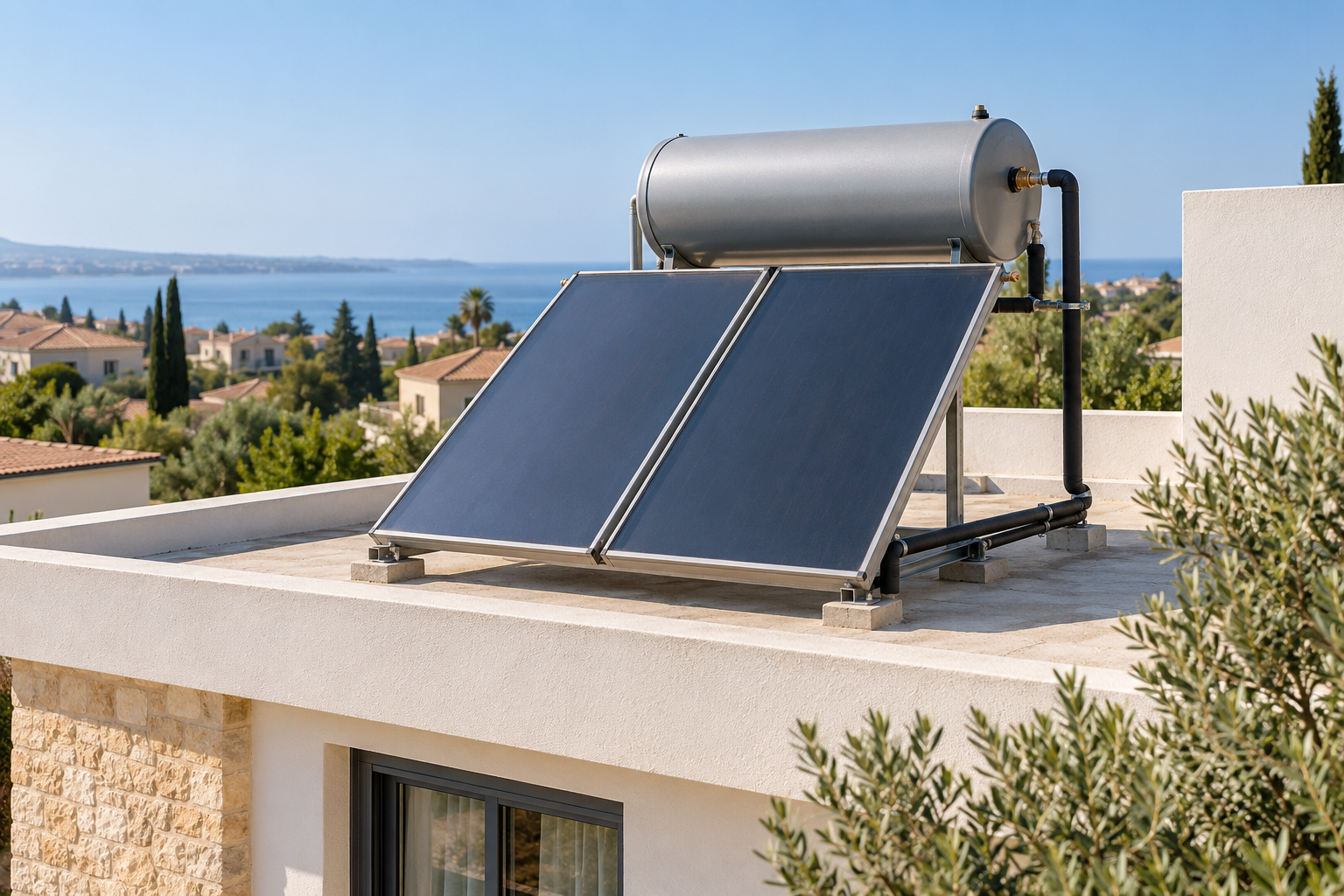
1. Start from the hot-water demand
The system should begin with the people and the use pattern, not with a catalogue package.
Important questions include:
- number of occupants;
- number of bathrooms;
- typical shower and bath use;
- whether several users need hot water in a short period;
- whether the property is occupied every day or seasonally;
- whether there are unusually large hot-water loads.
Two homes with the same number of bedrooms may have very different domestic-hot-water demand.
2. Match storage to the real use pattern
The cylinder stores useful heat so solar energy collected during the day can be used later.
A cylinder that is too small may run out during periods of concentrated demand even if the collectors are performing well. A cylinder that is unnecessarily large can increase standing losses, cost and the amount of water that must be heated.
Storage should therefore be considered together with collector input, household use and backup heating.
The correct question is not simply “How many litres per person?” A fixed rule can be a starting reference, but final selection should reflect the actual use pattern and the complete solar system.
3. Size the collector field together with the cylinder
Collector area determines how much solar energy the system can capture under available conditions. More collector area is not automatically better.
If the collector field is too small for the storage and demand, solar contribution may be limited. If it is excessively large relative to demand and storage, the system can experience excessive temperatures or prolonged stagnation when little hot water is being used.
Collector and cylinder selection should therefore be reviewed together.
4. Check orientation, inclination and shading
Before deciding collector area, inspect the roof or mounting location.
Check:
- orientation;
- available unshaded area;
- inclination;
- shading from parapets, neighbouring buildings, tanks, trees or other equipment;
- pipe route between collectors and cylinder;
- structural and fixing conditions.
A smaller collector field with good solar exposure may perform more predictably than a larger field with significant shading.
The actual roof geometry also determines whether the preferred collector arrangement can be installed safely and serviced later.
5. Decide how backup heating will work
Solar hot water should be designed with a clear backup strategy for periods when solar input is insufficient or hot-water demand is unusually high.
Depending on the installation, backup may involve an electric immersion heater, boiler, heat pump or another heat source.
The control strategy matters. Backup heating should provide the required service without unnecessarily heating the full cylinder at times when useful solar energy could otherwise be collected.
Compatibility between the cylinder, heat exchanger arrangement and backup source should be checked before equipment is ordered.
6. Check the cylinder heat-exchanger arrangement
Not every cylinder is interchangeable.
Depending on the system, the cylinder may need one or more coils, an electric immersion heater or specific connections for solar and backup heat sources.
The coil arrangement, connection positions and heat-transfer capability should suit the intended hydraulic circuit.
When replacing only the collectors or only the cylinder in an existing installation, verify the existing equipment instead of assuming that the old and new components are automatically matched.
7. Include the safety and hydraulic components in the design
The collectors and cylinder are only part of the system.
A complete solar-thermal installation may also require appropriate:
- circulation or thermosiphon arrangement;
- expansion provision;
- pressure-relief protection;
- check and isolation valves;
- air separation or venting provisions where applicable;
- temperature sensing and control;
- suitable solar-fluid components in closed-loop systems;
- thermostatic mixing protection at the hot-water outlet where required by the design.
These components affect reliability and safe operation. They should not be treated as accessories to choose after the main equipment.
8. Consider very hot summer conditions and low-use periods
A solar system must be able to tolerate periods of high solar input when hot-water use is low.
This can occur when occupants are away, in seasonal properties or during holidays.
The collector area, storage volume, system configuration and control strategy should therefore be assessed for both normal demand and low-demand periods—not only for winter performance.
9. Check the existing system before partial replacement
If a property already has solar hot water and only one component is being replaced, record the existing system first.
Useful information includes:
- cylinder capacity and model;
- collector type and dimensions;
- number of collectors;
- current roof arrangement;
- pipe sizes and routing;
- backup heat source;
- age and condition of valves, controls and insulation;
- existing performance complaints.
Replacing two old collectors with one new collector, for example, should be based on useful collector area and system compatibility rather than simply on the number of panels.
Common mistakes
Selecting cylinder litres from household size alone
Occupancy matters, but so do use pattern, collector field and backup strategy.
Selecting collectors separately from storage
The collector field and cylinder form one thermal system. They should be reviewed together.
Ignoring shading
Catalogue collector area does not help if part of the field spends important hours in shade.
Oversizing based on expected sunshine
Do not use a general impression of sunshine as a sizing method. Excess collector area can create unwanted high-temperature operation when demand is low.
Replacing one component without checking the rest
An existing cylinder, coil or controller may not be correctly matched to new collectors or a new backup source.
Information to collect before asking for a recommendation
Prepare:
- number of occupants;
- number of bathrooms;
- normal hot-water use pattern;
- whether the property is permanent or seasonal;
- roof photos from several angles;
- approximate available roof dimensions;
- orientation if known;
- photos and nameplates of existing collectors and cylinder;
- cylinder capacity if known;
- backup heat source;
- any existing hot-water complaints.
For a replacement project, dimensions and photos of the existing collector field are especially useful.
Practical recommendation
Treat solar hot water as a collector + storage + backup + hydraulic + control system.
The highest-leverage step before buying equipment is to document the real hot-water demand and the actual roof/existing-system conditions. That prevents both under-sizing and the common assumption that simply adding more collector area will always improve the result.
Conclusion and CTA
For a solar hot-water review in Cyprus, send Thomas Moudouros Ltd the number of occupants, cylinder capacity, collector dimensions or photos, roof photos and the existing backup-heating arrangement. Those details allow the system to be reviewed as a whole before selecting replacement collectors, a new cylinder or a complete solar package.
See the solar hot water category for related systems and components.