
Short answer
Choose a water filter by identifying the water source, the exact treatment objective, the required flow, the available pressure and the verified performance claim of the treatment device.
Do not start with the number of filter stages, the smallest micron figure or the assumption that reverse osmosis is automatically the best option.
A responsible selection process asks:
- What is the water source?
- Is the concern sediment, taste/odour, chlorine, hardness, a specific dissolved substance, or microbiological safety?
- Is there an official supply-zone result or a laboratory analysis that identifies the issue?
- Is treatment required for the whole property or only one drinking-water tap?
- What flow must pass through the treatment equipment?
- How much pressure loss can the system tolerate?
- What reduction claim is independently certified for the exact product?
- What maintenance and cartridge-replacement regime will actually be followed?
No single filter technology should be presented as solving every water-quality problem.
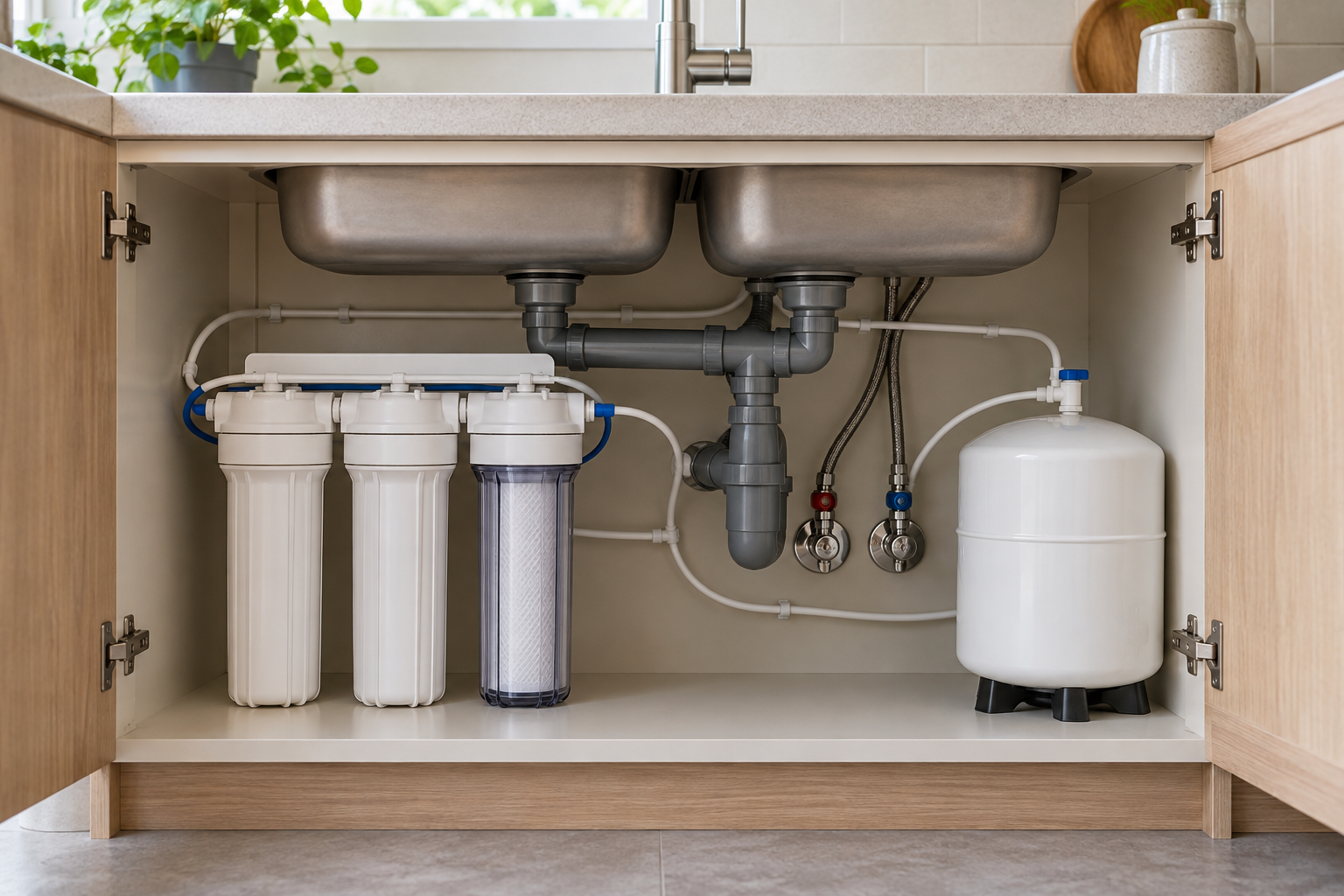
1. Start with the water problem, not the filter catalogue
The first decision is not “which cartridge?” It is “what are we trying to change?”
Typical objectives can include:
- visible sand, rust or suspended particles;
- taste or odour improvement;
- reduction of chlorine where an appropriate carbon product carries that claim;
- protection of valves, appliances or downstream treatment stages from sediment;
- reduction of a specific substance identified by analysis;
- reduction of dissolved salts or total dissolved solids where a suitable membrane system is required;
- microbiological treatment where a system has been specifically validated for that purpose.
These are different jobs and may require different technologies.
If the concern is specific and measurable, testing is stronger evidence than choosing equipment from appearance, taste or internet assumptions.
2. Cyprus has official drinking-water monitoring data
Cyprus' State General Laboratory and Public Health Services run drinking-water monitoring programmes and publish results, including results by water-supply zone.
The current national legal framework is aligned with EU Directive 2020/2184 on the quality of water intended for human consumption.
For a mains-water property, official supply-zone information can therefore be a useful starting point before paying for unnecessary treatment.
The State General Laboratory cautions that an individual published result alone does not mean the drinking water is unsafe. Interpret results in the context of the monitoring programme and competent-authority guidance.
A private building can still have conditions that are not represented by the public-network result—for example internal pipework, a private storage tank, or another local source. Where there is a specific concern at the tap, an appropriate sample and laboratory analysis may still be required.
Do not use a filter to conceal an unexplained water-quality problem that should first be investigated.
3. Point-of-entry and point-of-use systems solve different design problems
A point-of-entry (POE) system treats water entering a property or a large part of the installation.
A point-of-use (POU) system treats water at a specific outlet, commonly a drinking-water tap.
This distinction matters because the required flow can differ substantially.
A whole-property filter may need to pass simultaneous fixture demand with acceptable pressure loss. An under-sink drinking-water system may operate at a much lower flow but can have different requirements for membranes, storage, drain connection or dedicated tap.
Do not size a whole-house filter from the performance of a small drinking-water cartridge.
4. Sediment filtration is primarily a particle-control stage
Sediment cartridges are used to capture suspended particles according to the design and rating of the product.
They may be useful for:
- visible particulate matter;
- protecting downstream carbon or membrane stages;
- reducing dirt loading on equipment;
- acting as a prefiltration stage where required by a downstream device.
A sediment cartridge should not automatically be credited with removing dissolved salts, hardness, chlorine, microorganisms or a specific chemical contaminant unless the exact product has a validated claim for that purpose.
Micron rating needs context
A smaller micron number is not automatically a better system.
Finer filtration can increase pressure drop and shorten service life when particle loading is high. The meaning of a nominal or absolute rating also depends on the manufacturer's specification and test method.
Compare the complete product documentation, not only the number printed beside “micron”.
5. Activated carbon is useful only for the claims the product actually supports
Activated-carbon treatment is commonly used in drinking-water filtration, but performance depends on media, contact time, flow, cartridge design and the specific contaminant.
NSF explains that:
- NSF/ANSI 42 covers certified reduction claims for aesthetic effects such as chlorine and taste/odour;
- NSF/ANSI 53 covers certified reduction claims for contaminants with health effects.
The important word is claim.
Certification to a standard does not mean a product removes every contaminant covered somewhere within that standard. Check the exact certified reduction claim for the exact model.
Do not advertise a generic carbon cartridge as a universal purifier.
6. Ultrafiltration should be selected from verified membrane performance, not the letters “UF”
Ultrafiltration systems use a membrane, but membrane construction, pore characteristics, flow conditions and validated performance vary by product.
The label “UF” alone is not enough to conclude that a system makes microbiologically unsafe water safe.
If microbial reduction is required, use a system whose performance has been specifically evaluated for the target organism/class and operating conditions, and maintain it exactly as specified.
WHO's household-water-treatment programme uses defined test protocols because microbial performance must be demonstrated rather than assumed from the technology name.
7. Reverse osmosis is a different treatment process, not simply a “finer filter”
Point-of-use reverse-osmosis systems use a semipermeable membrane and normally require multiple components and operating conditions.
NSF/ANSI 58 covers reverse-osmosis drinking-water systems. TDS reduction is a required performance claim under the standard; optional reduction claims can include specific substances such as nitrate/nitrite, arsenic, lead, fluoride and others depending on the certified system.
Again, the exact model's certification matters.
Before choosing RO, check:
- what dissolved constituent or treatment objective justifies it;
- feed-water pressure requirements;
- pretreatment requirements;
- product-water flow;
- recovery/efficiency information;
- reject-water/drain connection;
- storage-tank arrangement where applicable;
- membrane and cartridge replacement requirements;
- effects on water chemistry relevant to the intended use.
A reverse-osmosis system should not be selected simply because it appears to be the most comprehensive technology.
8. Water softening is not ordinary filtration
Hardness is primarily associated with dissolved calcium and magnesium.
A sediment filter does not remove dissolved hardness simply by having a fine micron rating, and a carbon cartridge does not perform the same function as an ion-exchange softener.
If scale/hardness is the main problem, evaluate a water-softening system separately.
Likewise, if the objective is only sediment or taste/odour improvement, a full softener or RO system may be unnecessary.
Define the objective before choosing the process.
9. Tank-fed water requires the storage system to be considered too
If the building receives water through a private storage tank, the condition of that tank and its pipework forms part of the water-quality chain.
Review:
- tank suitability for potable water where applicable;
- lid and openings;
- contamination protection;
- water turnover;
- cleaning and maintenance;
- sediment accumulation;
- outlet arrangement;
- pump and pressure-system condition.
Installing a filter downstream does not remove the need to correct a contaminated, damaged or poorly maintained storage system.
10. Flow and pressure determine whether a filter works acceptably in the building
Every filter creates some hydraulic resistance.
Pressure loss can increase as:
- flow rises;
- filtration becomes finer;
- cartridges load with sediment;
- multiple stages are placed in series;
- undersized housings or connections are used.
For a whole-house system, compare the required building flow with the manufacturer's flow/pressure-drop data where available.
If the property already has marginal pressure, the filter should be considered together with the tank, booster pump and distribution pipework.
Adding a restrictive treatment train after the pressure system has been selected can create poor outlet performance even when each individual component appears correctly sized in isolation.
11. More stages do not automatically mean better treatment
A four-, five- or six-stage label is not an engineering performance specification.
Every stage should have a defined purpose.
A logical treatment train may use prefiltration to protect a downstream carbon or membrane stage, but unnecessary cartridges can add pressure loss, maintenance cost and extra failure/leak points.
Ask what each stage does and what evidence supports that function.
If the answer is only “more stages are better”, the system has not been properly specified.
12. Check certification at model and claim level
Independent certification can help verify that a product has been tested against a defined standard.
Useful checks include:
- certification body;
- exact manufacturer and model number;
- applicable standard;
- exact contaminant/reduction claim;
- rated capacity or service conditions where specified;
- required replacement components;
- whether the replacement cartridge itself is part of the certified configuration.
Do not transfer a certification claim from one cartridge in a product family to another cartridge that has not been certified for the same claim.
13. Microbiological safety requires special caution
A household filter should not be described as making unsafe water safe unless the complete system has demonstrated the required microbial performance and is operated within its validated conditions.
WHO evaluates household water-treatment technologies under defined protocols because different technologies and products can perform differently against bacteria, viruses and protozoa.
If microbiological contamination is suspected or confirmed, the response should be based on competent public-health/water-quality advice and a treatment process proven for the actual risk.
A taste-and-odour carbon filter is not a substitute for validated disinfection or microbial treatment.
14. Installation hygiene matters
Even a suitable filter can become a hygiene problem if installed or serviced carelessly.
Follow manufacturer instructions for:
- flushing new cartridges;
- sanitising housings where required;
- avoiding contamination of replacement cartridges during handling;
- sealing O-rings correctly;
- checking for leaks after service;
- replacing cartridges at the specified condition/interval;
- disposing of exhausted cartridges appropriately.
Do not allow an old cartridge to remain indefinitely because the water still “looks clear”.
15. Design for isolation, bypass and cartridge access
Before mounting housings, check that the installer will be able to remove them later.
Plan for:
- isolation valves;
- bypass where appropriate;
- pressure relief/depressurisation procedure required by the product;
- clearance below cartridge housings;
- safe drain/spill management during service;
- access to gauges or monitoring points if used;
- leak detection or containment where leakage could damage the building.
A system that cannot be serviced easily is less likely to be maintained correctly.
16. Replacement intervals are not universal
Cartridge life depends on:
- water quality;
- particle loading;
- consumption;
- flow;
- cartridge capacity;
- treatment objective;
- manufacturer limits;
- time in service.
Some products have capacity-based limits, some have time-based limits, and pressure drop or water-quality indicators may also matter.
Do not reuse a replacement interval from a different cartridge or installation unless the manufacturer supports it.
Common mistakes
Choosing by stage count
More stages can mean more pressure loss and maintenance without delivering a useful additional treatment function.
Choosing only by micron number
Micron rating does not describe removal of dissolved substances and does not by itself prove microbial safety.
Assuming every carbon filter has the same contaminant claims
Carbon products vary. Check the exact certified model and reduction claim.
Installing RO without a defined reason
RO can be appropriate for specific dissolved-water objectives, but it adds membrane, drain, recovery, pressure and maintenance considerations.
Treating hardness with a sediment filter
Dissolved hardness and suspended particles are different problems.
Ignoring building flow and pressure
A treatment train that is hydraulically restrictive can make taps and showers perform poorly.
Ignoring the storage tank upstream
A downstream filter does not excuse poor tank hygiene or maintenance.
Assuming clear water is automatically safe
Many water-quality parameters are not visible. Use official monitoring data or suitable testing where a specific concern exists.
Information to prepare before requesting a filter recommendation
Provide:
- water source: mains, private tank, borehole/well or other;
- official supply-zone result or laboratory analysis if available;
- exact concern or treatment objective;
- whole-property or single-outlet application;
- required flow if known;
- available static/dynamic pressure if known;
- pipe size;
- existing tank and booster-pump arrangement;
- installation-space dimensions;
- existing housings/cartridge codes if replacing equipment;
- photos of the installation location;
- any specific contaminant-reduction requirement;
- preference or requirement for independently certified treatment claims.
Practical recommendation
Use the least complicated treatment system that has a defensible, verified purpose for the actual water condition.
Start with evidence, then choose technology:
1. identify the source and problem;
2. review official data or obtain suitable analysis where needed;
3. decide point-of-entry versus point-of-use;
4. define flow and pressure constraints;
5. select the treatment technology;
6. verify the exact model's claims/certification;
7. design isolation and maintenance access;
8. follow the replacement and sanitation requirements.
This approach is more reliable than buying the system with the most stages or the most aggressive marketing description.
Conclusion and CTA
For help comparing water-filter options in Cyprus, send Thomas Moudouros Ltd the water source, treatment objective, any available water-analysis or supply-zone information, required application flow, available pressure, pipe size, installation dimensions and photos. This allows sediment, carbon, membrane and other treatment options to be compared against the actual problem without assuming that one technology is suitable for every building.