
Short answer
Choose a water-pressure pump from the required flow and required head at the same operating point, not from motor power, outlet size or a generic “house size” label alone.
A pump can have enough maximum pressure but still fail to provide the required flow when several outlets are open. The opposite is also possible: a pump may move a lot of water at low head but not maintain useful pressure at the highest or most remote fixture.
For a house, villa, apartment or small building in Cyprus, the correct selection starts by defining what the system must deliver at the worst realistic operating condition.
1. Define the required flow
Start with the expected simultaneous water demand. The design flow is not simply the sum of every tap at full flow, but it should reflect the fixtures that may realistically operate together.
For a small house, that may mean a shower, kitchen tap and another outlet operating at the same time. For a larger property, multiple bathrooms, irrigation or other users may change the duty point significantly.
The key question is:
How much water must the pump deliver when the system is under its highest realistic demand?
This value becomes the flow component of the duty point, normally expressed in litres per minute, litres per second or cubic metres per hour.
2. Calculate the head the pump must overcome
Required head is more than the pressure you want to see on a gauge.
It can include:
- the minimum pressure required at the highest or most demanding outlet;
- the vertical height between the pump or supply point and that outlet;
- pressure losses through pipework, fittings, valves, filters and other components;
- the effect of available inlet pressure at the design flow, where applicable.
Vertical elevation matters because the pump must add energy to lift the water. Pipe friction matters because pressure is lost as water moves through the network.
Treat inlet pressure as a boundary condition, not as another loss to add. Adequate available pressure can reduce the head the pump itself must add; confirm it at the design flow rather than relying only on a static reading.
A pump selected without these two elements can look correct on paper but perform poorly once installed.
3. Use the pump curve, not only the headline specification
Pump performance changes with flow. A pump does not normally provide its maximum advertised head while also providing its maximum advertised flow.
The useful operating point is where the pump performance curve and the system requirement meet.
When comparing pumps, check that the required flow and head occur together within a sensible operating region of the pump curve.
A model that reaches the required pressure only at almost zero flow is not automatically suitable for a domestic pressure system.
4. Avoid oversizing as well as undersizing
An undersized pump can produce low pressure, insufficient flow or poor performance at peak demand.
Oversizing is not a safe shortcut. A pump that is much larger than the system requires can increase energy consumption, noise and water velocity, and may operate away from its efficient region.
The objective is not to buy the strongest pump. It is to select a pump whose duty range matches the actual system.
5. Check the suction and inlet conditions
The pump must receive water correctly on the suction side.
Restrictions, excessive suction lift, undersized suction pipework, blocked strainers or poor inlet conditions can reduce performance and increase the risk of cavitation. Cavitation is associated with local pressure falling too low inside the pump and can cause noise, unstable performance and damage.
Where a pump draws from a storage tank, the relationship between water level, pump position and suction pipework should be checked before selection.
6. Decide how pressure will be controlled
Different domestic pressure systems can use different control strategies, for example:
- conventional pressure switch plus pressure vessel;
- electronic pressure controller;
- variable-speed constant-pressure control;
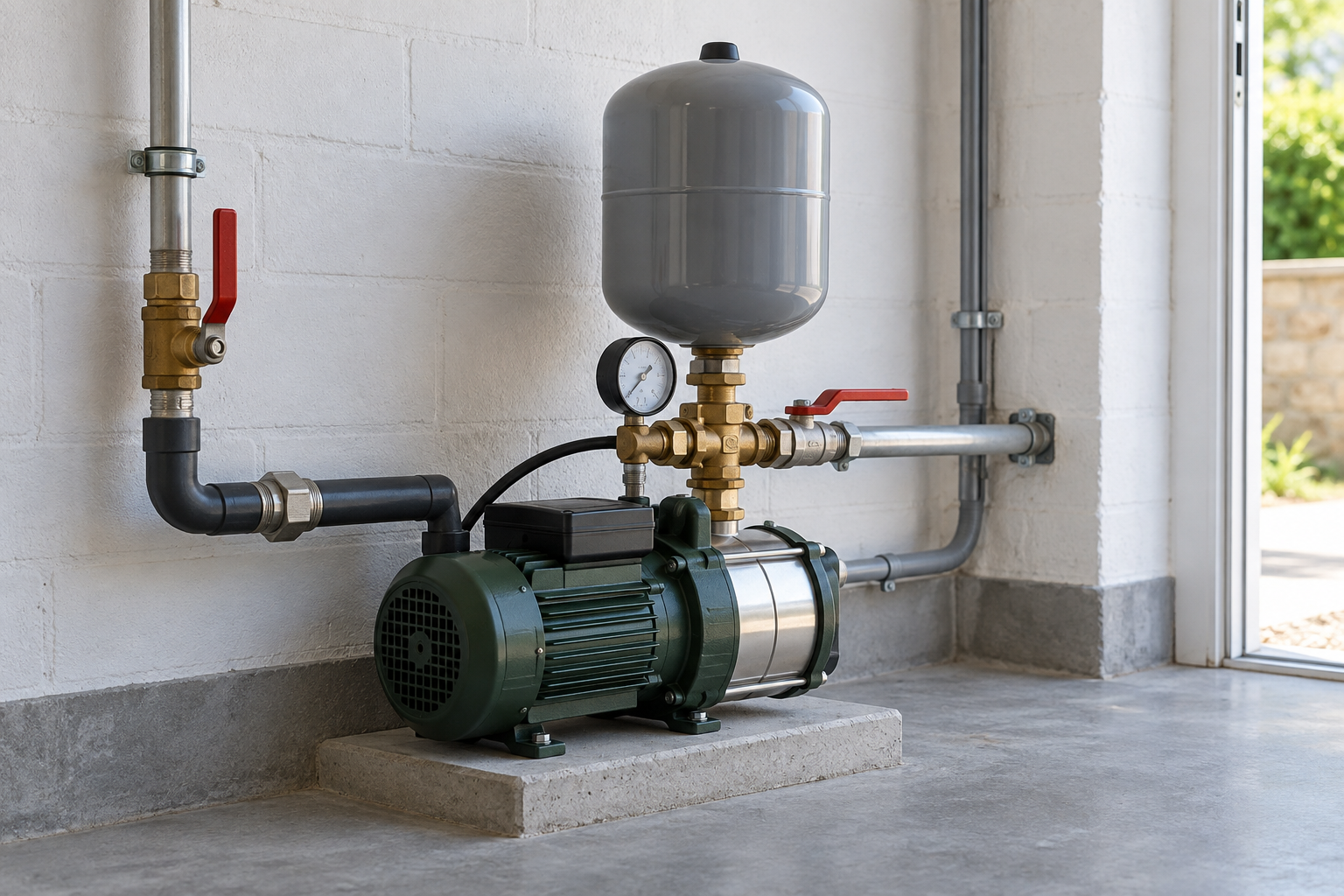
- integrated booster units with built-in controls.
The control method affects user comfort, cycling behaviour and the rest of the installation.
A pressure vessel is not just an accessory to add automatically. Its role and size depend on the system design and control strategy.
7. Check the rest of the hydraulic system
A new pump cannot correct every plumbing problem.
Before increasing pump size, check for:
- partially closed valves;
- clogged filters or strainers;
- undersized pipework;
- excessive friction loss;
- leaks;
- pressure-reducing valves set too low;
- blocked or damaged components;
- poor suction conditions.
If the network itself is restrictive, installing a larger pump may increase power consumption without solving the real bottleneck.
Common selection mistakes
Selecting by horsepower or kilowatts
Motor power alone does not tell you the delivered flow and head at the required duty point.
Selecting from maximum head only
Maximum head is normally reached near very low flow. Domestic systems need useful pressure while water is moving.
Ignoring the highest fixture
A pump may work well at ground level and still underperform upstairs if static height and pipe losses were not considered.
Assuming bigger is always better
Oversizing can create unnecessary cost, noise and inefficient operation.
Ignoring suction conditions
A pump cannot deliver its catalogue performance if the inlet side is starved or badly designed.
Information to collect before asking for a pump recommendation
For a useful technical selection, prepare:
- property type;
- number of bathrooms and important water users;
- expected simultaneous outlets;
- pump location;
- source of water: mains, tank or other supply arrangement;
- approximate vertical height to the highest outlet;
- pipe sizes if known;
- desired pressure at the outlets;
- existing pump model, if replacing one;
- photos of the current installation.
With those details, the selection can be based on a real duty point instead of guesswork.
Practical recommendation
For domestic water-pressure systems, start from flow + total head + inlet conditions + control method. Then compare the pump curve against that duty point.
A technically smaller pump operating in the correct region is often a better selection than a larger pump chosen only from maximum pressure or motor power.
Conclusion and CTA
If you need help selecting a pressure pump or complete pressure system in Cyprus, send Thomas Moudouros Ltd the number of bathrooms, water source, pump location, approximate height to the highest outlet and photos of the existing installation. That information is enough to begin a practical technical review before choosing equipment.