
Short answer
Do not choose a water softener only from the physical tank size or the number of bathrooms printed on a brochure.
A useful selection starts with measured water hardness, expected peak flow, daily water demand, required softening capacity and the regeneration arrangement.
The first step is therefore not buying equipment. It is confirming what problem the water actually has.
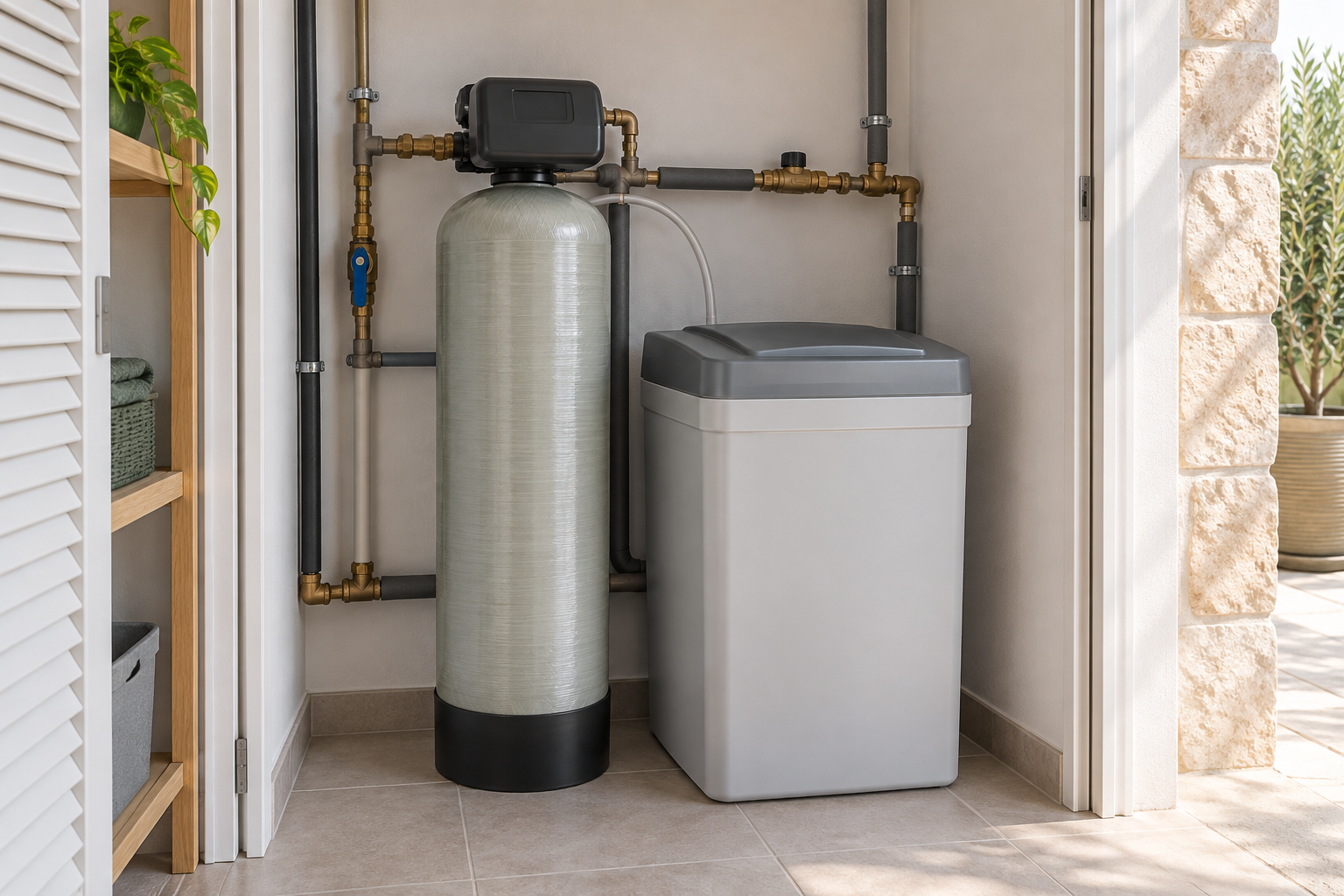
1. Confirm that hardness is the problem
Hard water is mainly associated with dissolved calcium and magnesium. These minerals can create scale deposits on heated surfaces, fixtures and equipment.
A water softener is designed specifically to reduce hardness. It is not the same as a sediment filter, activated-carbon filter or general water purifier.
If the complaint is taste, smell, visible particles, rust, microbiological contamination or another water-quality issue, a softener may not be the correct treatment on its own.
Before selecting equipment, test the water and identify the hardness level using a consistent unit such as mg/L as CaCO3 or an equivalent hardness scale.
2. Understand how ion-exchange softening works
A conventional softener passes water through ion-exchange resin.
During service, hardness ions are exchanged on the resin. After the resin has used a sufficient portion of its capacity, the unit regenerates using a brine solution so that the resin can return to service.
This means the softener is not a passive filter that can be selected only by connection size. Resin quantity, service flow and regeneration settings all matter.
3. Size for peak flow, not only average daily consumption
Two separate demands must be considered:
- capacity over time, which depends on water hardness and total water use;
- instantaneous service flow, which depends on how much water may be used at the same time.
A household may have moderate daily consumption but still experience a high short-duration flow when several showers or taps operate together.
If a softener is too small for the peak flow, hardness can pass through even if its theoretical daily capacity appears adequate.
This is why the valve, resin bed and complete unit must be checked against the expected peak demand.
4. Match resin capacity to hardness and water use
The harder the incoming water and the more water the property consumes, the faster the softener uses its available exchange capacity.
A practical sizing process should therefore consider:
- measured inlet hardness;
- expected daily water consumption;
- peak service flow;
- usable resin capacity between regenerations;
- desired regeneration frequency;
- reserve capacity so the unit does not run out unexpectedly.
The goal is not to maximize the time between regenerations at any cost. The goal is to operate the softener within the intended hydraulic and capacity range.
5. Check the control valve and regeneration method
Modern domestic softeners commonly use a metered control valve that tracks water use and initiates regeneration according to programmed capacity or demand.
When comparing units, check:
- service flow rating;
- backwash and regeneration flow requirements;
- connection sizes;
- drain connection requirements;
- brine tank arrangement;
- salt access and maintenance space;
- availability of electrical power where the valve requires it.
The valve must be able to handle the required service flow without creating excessive pressure loss.
6. Do not ignore the plumbing around the softener
A correctly sized softener can still perform poorly if the installation creates a bottleneck.
Check:
- incoming pipe diameter;
- bypass-valve arrangement;
- pressure before and after the unit;
- drain route for regeneration water;
- protection from dirt where prefiltration is required;
- adequate space for salt filling and servicing.
If the incoming water contains sediment, that problem should be assessed separately instead of expecting the softener resin to act as a dirt filter.
7. Decide which water should be softened
Not every outlet necessarily has to be connected through the softener.
The plumbing design should consider which fixtures and appliances benefit from softened water and whether any outlets should remain on untreated water.
This decision depends on the property, use case and water-quality requirements. It should be planned before pipework is finalized.
Common mistakes
Choosing from bathroom count alone
Bathroom count is a convenient sales shortcut, but it does not directly tell you the incoming hardness or the actual peak flow.
Buying a physically larger tank without checking capacity
Physical size is not the same as verified softening capacity or usable flow.
Ignoring peak flow
A unit may have enough total capacity for the day and still allow hardness leakage when demand exceeds its service capability.
Confusing filtration with softening
Sediment filters, carbon filters and softeners solve different problems. Water treatment should start from the actual water condition.
Setting regeneration without water data
Regeneration should be programmed from the system capacity, hardness and water-use assumptions rather than an arbitrary interval.
Information to collect before asking for a recommendation
Prepare:
- a recent hardness measurement or water analysis;
- number of occupants;
- number of bathrooms and major water users;
- expected simultaneous demand;
- incoming pipe size;
- available water pressure;
- installation location and available space;
- drain availability;
- photos of the incoming water line and proposed installation point.
If there are other water-quality complaints, include them as well so the treatment system is not designed around hardness alone.
Practical recommendation
For a domestic softener, start with water analysis + peak flow + daily demand + resin capacity + regeneration conditions.
A unit selected only because it is advertised for a certain number of people or bathrooms may be either too small for the hydraulic demand or unnecessarily large for the actual water hardness.
Conclusion and CTA
If you need help reviewing a water-softening system in Cyprus, send Thomas Moudouros Ltd the hardness result, number of occupants, bathrooms, incoming pipe size and a photo of the proposed installation point. These details allow a useful technical discussion before selecting the softener and related filtration components.