
Short answer
Choose a water storage tank from the required usable reserve, incoming-water conditions, demand profile, installation location, potable-water requirements and the hydraulic system connected to it.
Do not select only from a nominal litre figure.
A suitable design also needs to answer:
- how much water the building actually needs during the required reserve period;
- how quickly the tank can refill;
- how much of the nominal volume is genuinely usable;
- whether the tank feeds outlets by gravity or through a booster pump;
- where overflow water can discharge safely;
- how the tank will be isolated, inspected and cleaned;
- whether the supporting structure can carry the full operating mass;
- how potable water will be protected from contamination and stagnation.
There is no responsible universal litres-per-person value that should be applied to every Cyprus building without checking the project.
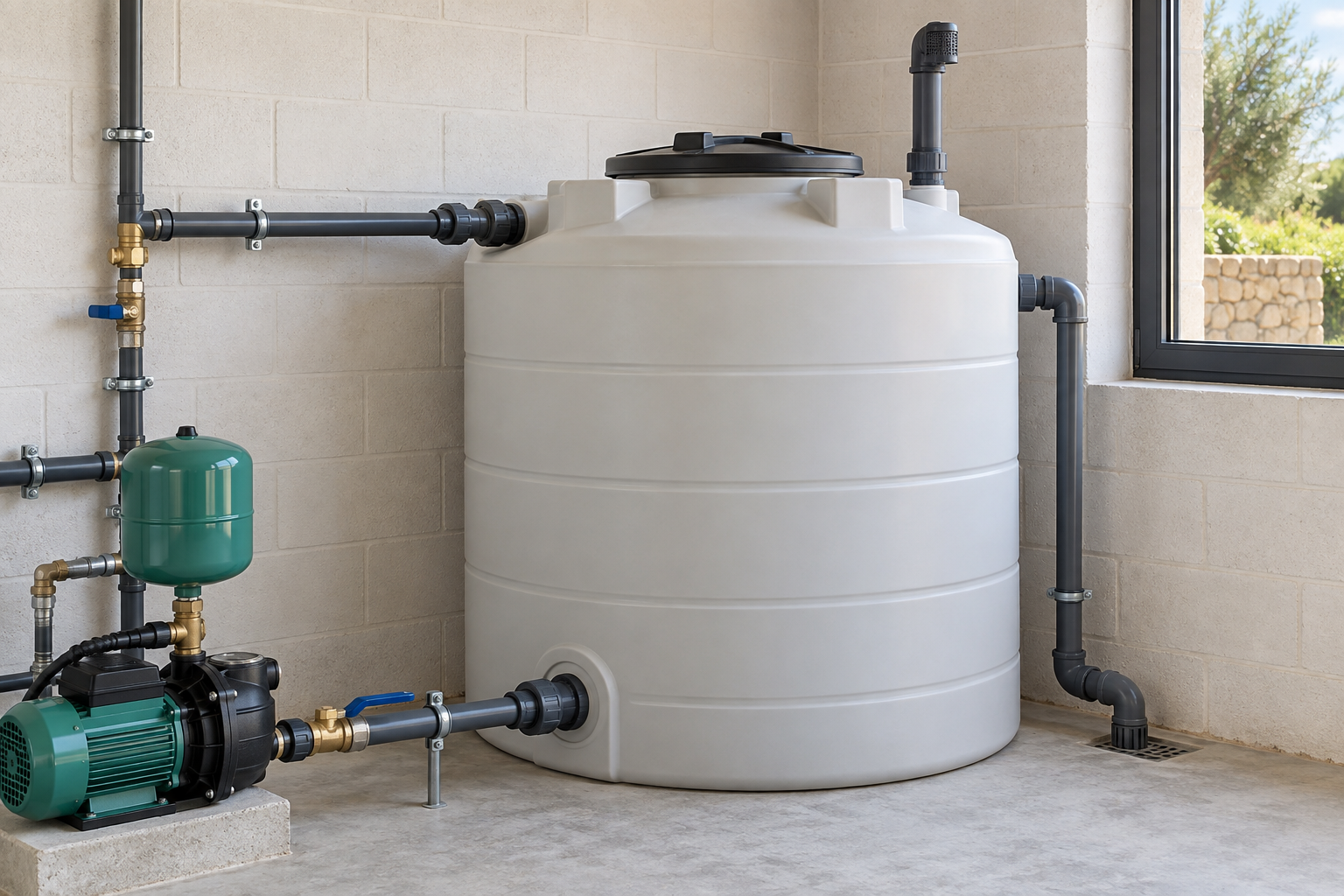
1. First decide what the tank is supposed to do
A storage tank can serve different purposes.
Examples include:
- providing reserve water when the incoming supply is interrupted;
- buffering a building whose peak demand is higher than the incoming refill rate;
- feeding a pressure-boosting system;
- serving a particular zone or group of outlets;
- separating a private installation hydraulically from the incoming supply where the design requires it.
The required capacity depends on the actual purpose.
A tank intended only to smooth short demand peaks should not automatically be sized the same way as a tank intended to provide a long reserve period.
2. Do not confuse a storage tank with a pressure vessel
These are different components.
A water storage tank or cistern normally stores a relatively large quantity of water at or close to atmospheric pressure.
A pressure vessel in a booster-pump system contains a much smaller water/air working volume and is used to control pressure-system operation, reduce rapid pump cycling and accommodate pressure changes according to the system design.
One does not automatically replace the other.
If a building needs both stored-water reserve and boosted pressure, the hydraulic arrangement may include a storage tank, pump set, controls and a pressure vessel as separate components.
3. Define the required reserve period before choosing litres
Start with the project requirement rather than a catalogue size.
Ask:
- How many people or users does the system serve?
- Is the use residential, commercial, hospitality or another type?
- Which fixtures or processes depend on the stored water?
- What is the actual or reasonably estimated consumption profile?
- How long must the building operate from storage if refill is unavailable or restricted?
- Is partial service acceptable during that period, or is full normal demand expected?
The reserve period may be expressed in hours or days, but the required value is a project decision. It should reflect the actual supply conditions, user expectations and any project-specific requirements.
Where historical meter data exists, it is usually more useful than a generic rule of thumb.
4. Calculate usable volume, not only nominal tank volume
The number printed on the tank is not always equal to the quantity available to the building.
Usable volume can be affected by:
- the height of the outlet connection;
- pump low-level protection or float-switch settings;
- inlet and overflow levels;
- minimum level needed to avoid drawing air or sediment;
- pipe geometry and tank shape;
- control setpoints;
- any reserve that is intentionally kept unavailable for another purpose.
The design should therefore distinguish nominal volume from usable operating volume.
If a pump is connected, the low-level cut-out arrangement is particularly important because the pump should not be expected to operate normally after the usable level has fallen below its safe suction condition.
5. Refill rate can matter as much as storage volume
A tank is not necessarily filled once and then emptied completely.
In normal use, incoming water may be replenishing the tank while the building is drawing from it.
Consider:
- incoming flow rate;
- periods of low incoming pressure;
- restrictions imposed by the inlet valve or pipework;
- peak building demand;
- how quickly the selected tank can recover after a high-demand period.
A larger tank does not correct an undersized or badly restricted refill path if the building repeatedly consumes water faster than it can recover.
Likewise, a very large tank can create excessive residence time if water turnover is low.
6. Avoid unnecessary stagnation
Potable-water design is not only a capacity problem.
CYS EN 806-5 addresses operation and maintenance, while CYS CEN/TR 16355 gives recommendations for preventing Legionella growth in potable-water installations. EN 1717 concerns protection against pollution by backflow. Low turnover can create long residence times; any water-quality risk depends on temperature, materials and operating conditions.
For that reason, “bigger is always safer” is not a good storage rule.
The objective is enough usable reserve for the project without creating unnecessary stored volume that rarely turns over.
For buildings with highly variable occupancy, the operating strategy should be considered as well as the tank size.
7. Use a tank suitable for potable water where drinking-water storage is required
If the stored water is part of a potable-water installation, the tank and all components in contact with the water should be suitable for that intended use and supported by the relevant product documentation.
Check the selected product for:
- declared intended use;
- material suitability for potable water;
- temperature limitations;
- UV/external-exposure limitations where relevant;
- inlet, outlet, overflow and drain connection details;
- lid and access arrangement;
- installation and support requirements;
- cleaning and maintenance instructions.
Do not assume that every plastic container is suitable for storing water intended for human consumption.
8. Protect the stored water from external contamination
A potable-water tank should be arranged so that debris, insects, animals, surface water and other contaminants cannot readily enter it.
Practical design details include:
- a secure, close-fitting lid;
- appropriately protected vents or openings;
- a properly arranged overflow/warning connection;
- keeping contamination sources away from openings;
- preventing dirty surface water from entering through access points;
- maintaining access for inspection without leaving the tank exposed in normal operation.
EN 1717 addresses the protection of potable-water installations against pollution by backflow. The required protection method depends on the hydraulic arrangement and risk category; select it for the actual installation. Confirm the edition applicable in Cyprus and the project requirements with CYS or the responsible designer.
9. Plan the overflow before installation
The overflow is not an optional afterthought.
If the inlet control fails or the incoming water continues after the normal level is reached, the system needs a safe path for excess water.
Before positioning the tank, identify:
- the overflow connection size and location specified for the tank/system;
- where overflow water can discharge visibly and safely;
- whether the route can cause flooding or damage if it operates continuously;
- how insects or contaminants will be prevented from entering through the opening;
- whether the overflow arrangement remains accessible for inspection.
Do not install a tank first and then improvise an overflow route because the available pipe path is inconvenient.
10. Structural load can be substantial
Water is heavy.
As a useful engineering approximation, one litre of water has a mass of about one kilogram. A nominal 1,000-litre tank can therefore contain roughly 1,000 kg of water before adding the tank itself, pipework, support frame and dynamic/service effects.
That load must be transferred safely to the supporting structure.
For roof, loft, platform or elevated installations, confirm:
- the support surface and structural capacity;
- the manufacturer's base-support requirements;
- load distribution;
- access for installation and future replacement;
- safe maintenance access;
- consequences of leakage or overflow.
A flat-looking roof or slab should not be assumed to be adequate without the appropriate structural check.
11. Outdoor and roof installations need exposure planning
If an external, roof or plant-area location is proposed in Cyprus, solar exposure and high ambient temperatures may need to be considered.
Check the manufacturer's requirements for:
- UV exposure;
- ambient temperature;
- tank colour or external finish where applicable;
- shading or enclosure restrictions;
- ventilation around enclosed plant areas;
- pipe insulation and protection;
- access for inspection and replacement.
Do not wrap or enclose a tank in a way that conflicts with its installation instructions or prevents routine inspection.
12. Design the pump connection as a hydraulic system
Where a booster pump draws from the tank, tank selection and pump selection should be coordinated.
Review:
- tank outlet size and position;
- suction-pipe diameter and length;
- available static head at the pump inlet;
- restrictions from valves, strainers and fittings;
- pump manufacturer's suction/NPSH requirements;
- low-level protection;
- dry-run protection;
- pump duty point;
- pressure-vessel and control strategy where applicable.
A correctly sized storage tank cannot compensate for a poor suction arrangement.
Conversely, an oversized pump can create undesirable operating conditions if the tank outlet and suction path cannot supply it properly.
13. Provide isolation, drain-down and maintenance access
A storage system eventually needs inspection and maintenance.
Plan for:
- an accessible isolation valve;
- a practical drain-down method;
- safe access to the lid and internal inspection point;
- access to float valves, level sensors and controls;
- cleaning without dismantling unrelated building services;
- replacement access if the tank must be removed in future.
CYS EN 806-5 specifically addresses operation and maintenance of potable-water installations. Maintenance access is therefore part of good system planning, not merely a convenience for the installer.
14. Keep different water systems clearly separated
A building may contain potable water, irrigation water, rainwater, fire water, heating water or other fluids.
These systems should not be casually interconnected.
Where alternative water sources or non-potable systems exist, the backflow and separation requirements need to be assessed for the specific installation. EN 1717 provides the risk-analysis framework for protecting potable water against backflow pollution.
Labelling, pipe identification and clear hydraulic separation also reduce the risk of future maintenance errors.
Common mistakes
Selecting from litres alone
Nominal capacity does not tell you the usable reserve, refill performance, water turnover or installation suitability.
Applying a universal litres-per-person rule
Occupancy, use profile, refill continuity and required autonomy vary between projects.
Using a pressure vessel as if it were a storage tank
The two components have different hydraulic functions.
Ignoring the full operating mass
A large tank can impose a substantial structural load when full.
Leaving overflow routing until the end
Overflow failure can become a building-flooding problem if there is no safe discharge path.
Oversizing “for safety” without checking turnover
Excessive stored volume can increase residence time and stagnation risk.
Connecting a booster pump without checking suction conditions
Pump reliability depends on the tank outlet and the complete suction path, not only the pump's headline pressure rating.
Making the tank impossible to clean or replace
Access must be considered before walls, roofs, enclosures or other services block the route.
Information to prepare before requesting a quotation
For a useful tank and system selection, prepare:
- building type and number of users;
- actual water-use information or meter history if available;
- required reserve/autonomy period;
- incoming water source and known supply limitations;
- available incoming pressure and flow if known;
- proposed tank location;
- maximum available dimensions and access route;
- whether the tank is indoors, outdoors, on a roof or at ground level;
- whether gravity supply or a booster pump will be used;
- required pump duty if already calculated;
- existing pipe sizes and connection details for renovation work;
- photos or drawings of the proposed location;
- any project specification for potable-water materials or controls.
Practical recommendation
Treat the tank as part of the complete water system.
Start from the required reserve and actual demand, then verify refill rate, usable volume, potable-water suitability, structural support, overflow, maintenance access and pump integration.
A smaller tank with adequate turnover and a correctly designed refill/booster arrangement can be a better system than a very large tank selected only because more litres appear safer.
Conclusion and CTA
For help reviewing water-storage and pressure-system options in Cyprus, send Thomas Moudouros Ltd the building type, number of users, desired reserve period, incoming-water information, proposed tank location, available dimensions and any pump or plumbing drawings. This allows the storage capacity and connected hydraulic components to be reviewed together before quotation.
See the water storage tank category and confirm that the exact model suits the application and project requirements.